
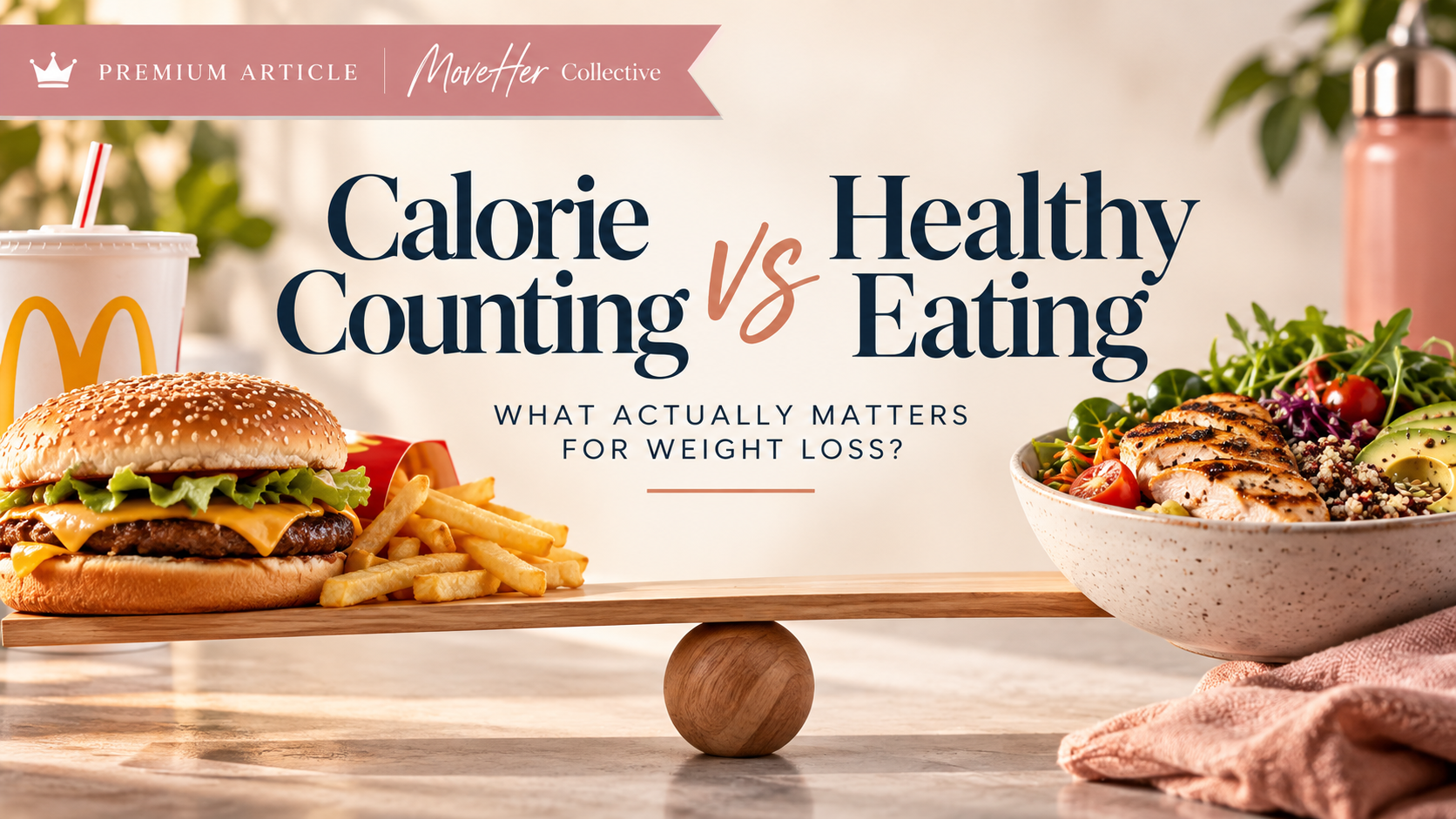
What Actually Matters for Weight Loss?
We hear it all the time:
“I’m eating really healthily, but I’m not losing weight.”
You’ve swapped the biscuits for nuts. You’re having avocado on toast. You’ve ditched the takeaway and started making homemade meals. Your shopping basket looks healthier than it has in years…
…but the scales aren’t moving.
So what’s going on?
The answer comes down to something that can sometimes get lost amongst conversations about “clean eating”, low-fat foods, low-carb diets, points, syns and healthy choices:
Energy balance still matters.
You absolutely can lose weight without counting a single calorie.
But you cannot bypass the basic energy equation that causes fat loss.
Let’s explain.
FIRST: WHAT IS TDEE?
Your body uses energy every single day — even if you don’t exercise.
You need energy to breathe, circulate blood, regulate body temperature, digest food, move around, exercise and simply keep your body functioning.
The total amount of energy you use across the day is known as your Total Daily Energy Expenditure — TDEE.
Your TDEE is made up of several things, including:
Your resting energy needs
The energy required simply to keep you alive and functioning.
Everyday movement
Walking around the house, doing the school run, cleaning, taking the stairs, working and generally moving throughout the day.
Exercise
Your workouts, classes, running, walking, strength training and other intentional activity.
Digestion
Even processing the food you eat requires some energy.
Put everything together and you get your approximate daily energy expenditure.
And this is where weight loss comes in.
THE CALORIE DEFICIT
If your body uses more energy than you consume over time, there is an energy shortfall.
This is known as a calorie — or energy — deficit.
Your body then has to obtain that missing energy from stored sources within the body.
Over time, an appropriate sustained energy deficit results in loss of body tissue, including body fat.
On the other hand, if you consistently consume more energy than your body needs, that excess energy can be stored.
So although there are countless diets, programmes and approaches to weight loss, the underlying mechanism hasn’t changed:
Sustained fat loss requires an energy deficit.
That doesn’t mean you need to spend your life entering everything you eat into an app.
It simply means that whether you count the calories or not, they still exist.
“BUT I EAT HEALTHILY…”
This is where things become interesting.
Because healthy eating and eating for weight loss aren’t exactly the same thing.
There is a huge overlap — and ideally we want both.
But eating nutritious foods does not automatically mean you are consuming fewer calories than your body needs.
Take foods such as:
🥑 Avocado
🥜 Nuts
🥄 Nut butters
🫒 Olive oil
🥣 Granola
🧀 Cheese
🥤 Smoothies
There is absolutely nothing wrong with these foods.
Many of them provide valuable nutrients and can form part of a brilliantly balanced diet.
But they can also contain a lot of energy in relatively small portions.
You could eat nutritious, predominantly whole foods all day and still consume more energy than your body uses.
Healthy calories are still calories.
That doesn’t make the food “bad”.
It simply means that portion size and overall intake still matter when fat loss is the goal.
SO WHAT ABOUT SLIMMING WORLD AND WEIGHTWATCHERS?
Programmes such as Slimming World and WeightWatchers can sometimes make it feel as though we’re doing something completely different from calorie counting.
Instead of calories, we might think about Free Foods, Syns or Points.
But underneath the system, energy intake still matters.
Slimming World, for example, encourages people towards foods that are generally lower in energy density and more filling — meaning you can eat a satisfying volume of food for fewer calories.
WeightWatchers uses its Points system to guide food choices, with the current system considering factors including calories alongside protein, fibre, fats and added sugar.
Neither system changes the laws of energy balance.
Instead, they provide different ways of managing food intake without necessarily asking someone to count every calorie directly.
And for some people, that structure can be incredibly useful.
For others, calorie tracking works better.
And some people may need neither.
The important point is this:
You don’t have to count calories for calories to count.
THE McDONALD’S EXPERIMENT 🍟
Here’s an example that demonstrates the difference between weight loss and healthy eating particularly well.
In 2014, Iowa science teacher John Cisna attracted attention after eating meals from McDonald’s three times a day for 90 days.
You might expect to hear that he gained a considerable amount of weight.
Instead, he reported losing 37 lb.
So… does that mean McDonald’s is a weight-loss diet?
Of course not.
There was an important part of the experiment hidden behind the attention-grabbing headline.
Cisna planned his food around approximately 2,000 calories per day, paid attention to nutritional guidelines and also introduced regular walking.
Despite eating McDonald’s, his overall energy intake was controlled.
The experiment wasn’t a clinical trial and shouldn’t be treated as proof that eating fast food three times a day is a healthy approach.
But it does illustrate an important principle:
The fact that a food is labelled “unhealthy” doesn’t somehow prevent weight loss if an overall energy deficit exists.
And the opposite is also true.
The fact that a food is labelled “healthy” doesn’t guarantee weight loss if you’re consuming more energy than you expend.
BUT THERE’S AN IMPORTANT CATCH…
At this point you could understandably think:
“So if calories determine weight loss, does it actually matter what I eat?”
YES.
Very much so.
Because the number on the scales isn’t the only reason we eat.
Food provides protein, carbohydrates, fats, fibre, vitamins, minerals and many other compounds our bodies need.
It fuels our training.
It supports recovery.
It affects digestion.
It influences how satisfied we feel after eating.
And food quality can make maintaining an energy deficit significantly easier.
Imagine two people eating the same number of calories.
One person’s diet contains plenty of vegetables, fruit, whole grains, fibre-rich carbohydrates, protein and appropriate amounts of healthy fats.
The other’s contains predominantly sweets, crisps, biscuits and fast food.
The calorie totals could theoretically be identical.
But the nutritional quality, fibre, protein, micronutrients, meal volume and overall eating experience could be completely different.
Calories tell us how much energy food contains.
They don’t tell us everything about the nutritional quality of that food.
We need to consider both.
500 CALORIES IS STILL 500 CALORIES… BUT THE EXPERIENCE CAN BE VERY DIFFERENT
This is where healthy eating becomes particularly useful when fat loss is your goal.
Think about how quickly you could eat several hundred calories of chocolate, biscuits or crisps.
Now imagine trying to get the same number of calories from a meal containing lean protein, potatoes, lots of vegetables and salad.
The second meal could be physically much larger.
It may contain considerably more protein and fibre.
And it may keep you satisfied for much longer.
That matters.
Because while creating an energy deficit is the mechanism behind fat loss, being able to comfortably maintain that deficit is what makes an approach practical.
If you’re permanently starving, miserable and thinking about food all day, it’s unlikely to be an enjoyable or sustainable way to live.
DO I NEED TO COUNT CALORIES?
No.
Calorie counting is a tool, not a requirement.
Some people love the information it gives them.
Tracking for a period can help you understand portion sizes and reveal calories you hadn’t realised were contributing significantly to your intake.
That drizzle of olive oil.
The handful of nuts while making dinner.
The milky coffees.
The kids’ leftovers.
The weekend drinks.
The sauces and dressings.
None of these foods needs to be banned.
But small amounts can add up.
For some people, tracking helps make those patterns visible.
For others, however, logging everything they eat feels tedious, restrictive or simply isn’t something they want to do.
That’s fine too.
You can create an energy deficit through habits and portion awareness without knowing the exact calorie content of every meal.
A DIFFERENT WAY TO THINK ABOUT IT
Instead of asking:
“How little can I eat?”
Try asking:
“How can I make my meals satisfying, nutritious and appropriate for what my body needs?”
Build meals around a good source of protein.
Include vegetables and fruit regularly.
Choose fibre-rich carbohydrates.
Include fats — remembering that relatively small portions can provide significant energy.
Pay attention to portions.
Eat foods you genuinely enjoy.
Move your body.
And remember that your diet doesn’t have to be perfect.
You don’t need to remove bread.
You don’t need to fear carbohydrates.
You don’t need to survive on salads.
And you certainly don’t need to classify every food as either “good” or “bad”.
HEALTHY EATING OR CALORIE COUNTING?
It doesn’t need to be one versus the other.
If fat loss is your goal, energy balance matters.
If health, nutrition, performance and feeling good matter to you, food quality matters too.
And if you want an approach you can actually maintain, enjoyment, flexibility and satisfaction matter enormously.
So perhaps the goal isn’t:
Calorie counting OR healthy eating.
It’s understanding what each one actually does.
You don’t have to obsess over numbers.
You don’t have to eliminate your favourite foods.
And eating something higher in calories doesn’t mean you’ve “ruined” your diet.
Instead, understand the bigger picture.
Calories matter for fat loss.
Nutrition matters for health.
Your habits make both sustainable.
And when we stop treating those things as competing ideas, healthy weight management becomes a lot less confusing.
MoveHer Collective
Information in this article is for general education and isn’t intended to replace personalised medical or nutritional advice.

About the Author
Jade Deverill is the founder of MoveHer Co. and is passionate about helping women build strength, confidence, and lifelong healthy habits through movement. With a supportive, down-to-earth coaching style, Jade believes fitness should empower rather than intimidate, creating spaces where women of all ages and abilities feel welcome to move, learn, and thrive.
Through MoveHer Co, Jade shares practical advice, evidence-informed guidance, and real-world strategies to help women feel stronger—not just physically, but mentally and emotionally too. Her mission is simple: to help every woman discover that strength is about far more than the weight you lift—it’s about believing in what you’re capable of every single day.